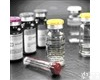
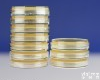
牛津琼脂(OXA)平板(9cm)图片实验内容
1.称量→溶化→调pH→过滤→分装→加塞→包扎→灭菌→无菌检查
2.干热灭菌:装入待灭菌物品→升温→恒温→降温→开箱取物
3.高压蒸汽灭菌:加水→装物品→加盖→加热→排冷空气→加压→恒压→降压回零→排汽→取物→无菌检查
4.过滤CJ:组装灭菌→连接→压滤→无菌检查→清洗灭菌
产品名称:
牛津琼脂(OXA)平板(9cm)图片英文名称: Oxford Agar ba
se
产品规格: 10个/包
产品用途:用于单增李氏菌的选择性分离
 牛津琼脂(OXA)平板(9cm)图片
特点:
(1)MS培养基 它是1962年由Murashige和Skoog为培养烟草细胞而设计的。特点是无机盐和离子浓度较高,为较稳定的平衡溶液。其养分的数量和比例较合适,可满足植物的营养和生理需要。它的硝酸盐含量较其他培养基为高,广泛地用于植物的器官、花药、细胞和原生质体培养,效果良好。有些培养基是由它演变而来的。
(2)B5培养基 是1968年由Gamborg等为培养大豆根细胞而设计的。其主要特点是含有较低的铵,这可能对不少培养物的生长有YZ作用。从实践得知有些植物在B5培养基上生长更适宜,如双子叶植物特别是木本植物。
(3)White培养基 是1943年由White为培养番茄根尖而设计的。1963年又作了改良,称作White改良培养基,提高了MgSO4的浓度和增加了鹏素。其特点是无机盐数量较低,适于生根培养。
(4)N6培养基 是1974年朱至清等为水稻等禾谷类作物花药培养而设计的。其特点是成分较简单,KNO3和(NH4)2SO4含量高。在国内已广泛应用于小麦、水稻及其他植物的花药培养和其他组织培养。
(5)KM-80培养基 它是1974年为原生质体培养而设计的。其特点是有机成分较复杂,它包括了所有的单糖和维生素,广泛用于原生质融合的培养。
牛津琼脂(OXA)平板(9cm)图片操作步骤:
(一)准确称量试剂:根据不同的菌类和用途,选择适宜的培养基,培养基所需试剂必须纯净。
(二)校正pH值:将称量好的培养基各种成分放入容器内,标记划线,加热溶解,补充水分,测定酸碱度,常用pH6.8~8.0的精密试纸或酸度计测定。用1N NaOH和1N HCl调节pH值到适宜范围内。
(三)过滤:将玻璃漏斗置铁架上,再用纱布夹棉花或用滤纸放在漏斗中,将上述培养基倒入其中过滤至透明。
(四)分装:将过滤后的培养基分装于中试管或三角瓶内(试管内每支装5mL;三角瓶中装100~150ml),塞好棉塞用牛皮纸包扎好,准备灭菌。
(五)灭菌:培养基的灭菌,常用高压蒸汽灭菌法。一般微生物的营养细胞在水中煮沸后即被杀死,但细菌的芽胞有较强的抗热性,须经高压蒸汽灭菌才能达到彻底灭菌的目的。根据蒸汽温度随压力升高而上升的原理,即压力越大,蒸汽温度就越高。因此,在同一温度条件下,采用高压蒸汽灭菌比干热灭菌法效果要好。而且在湿热情况下,菌体吸收水分后,其蛋白质易于凝固变性,因为蒸汽的穿透力强,杀菌效果好。
EDTA FREE ACLD 乙二胺四乙酸 Amresco 500g
EGTA 乙二醇-双-(2-氨基乙基)四乙酸 Amresco 5g
EGTA 乙二醇-双-(2-氨基乙基)四乙酸 Amresco 10g
Ethidium Brmide 溴化乙锭 Amresco 100mg
Ethidium Brmide 溴化乙锭 Amresco 1g
EB染色液 Solarbio 5ml
Eosin Y 伊红Y(醇溶) 进口分装 10g
Eosin Y 伊红Y(水溶) Amresco 10g
EDAC 1-乙基-(3-二甲基氨基丙基)碳二亚胺盐酸盐 进口分装 25g
NN'Dicyclohexylcarbodie?N,N'-二环己基碳二亚胺(DCC) 国产 25g
Fluorescein Sodium Salt荧光素钠 sigma 50g
Formamide,Deio
nized 去离子甲酰胺 Amresco 100mL
Formamide 甲酰胺 Amresco 100ml
弗氏不完全佐剂(含说明) From Sigma F5506 10ml
弗氏完全佐剂(附详细说明) From Sigma F5881 10ml
similarity). Tyr-27-phosphorylated form is located both in the cytoplasm and plasma membrane. CAV1-mediated Ser-23-phosphorylated form locates to the plasma membrane. Ser-36-phosphorylated form resides in intracellular compartments.
Function : May act as a scaffolding protein within caveolarmembranes. Interacts directly with G-protein alpha subunits and canfunctionally regulate their activity. Acts as an accessory proteinin conjunction with CAV1 in targeting to lipid rafts and drivingcaveolae formation. The Ser-36 phosphorylated form has a role inmodulating mitosis in endothelial cells. Positive regulator ofcellular mitogenesis of the MAPK signaling pathway. Required forthe insulin-stimulated nuclear translocation and activation ofMAPK1 and STAT3, and the subsequent regulation of cell cycleprogression (By similarity).
Subunit : Monomer or homodimer. Interacts with CAV1; theinteraction forms a stable heterooligomeric complex that isrequired for targeting to lipid rafts and for caveolae formation.Tyrosine phosphorylated forms do not form heterooligomers with theTyr-19-phosphorylated form existing as a monomer or dimer, and theTyr-27-form as a monomer only. Interacts (tyrosine phosphorylatedform) with the SH2 domain-containing proteins, RASA1, NCK1 and SRC.Interacts (tyrosine phosphorylated form) with INSR, the interaction(Tyr-27-phosphorylated form) is increased on insulin stimulation.Interacts (Tyr-19 phosphorylated form) with MAPK1 (phosphorylatedform); the interaction, promoted by insulin, leads to nuclearlocation and MAPK1 activation. Interacts with STAT3; theinteraction is increased on insulin-牛津琼脂(OXA)平板(9cm)图片nduced tyrosinephosphorylation leading to STAT activation (By similarity).
Subcellular Location : Nucleus. Cytoplasm. Golgi apparatusmembrane; Peripheral membrane protein. Cell membrane; Peripheralmembrane protein. Membrane, caveola; Peripheral membrane protein.Note=Potential hairpin-like structure in the membrane. Membraneprotein of caveolae. Tyr-19-